Learning-Deep-Learning
Requirements to compute hardware between training and inference
Comparison between training, cloud-inference, and edge-inference
Training improves the model, cloud inference serves users, and edge inference controls the physical world.
| Dimension | Training | Cloud Inference | Edge Inference |
|---|---|---|---|
| Objective | Model quality | Scale + cost | Real-time control |
| Mode | Offline | Online | Closed-loop |
| Batch | Large | Medium | 1 |
| Latency Requirements | None | Low | Hard real-time |
| Scaling | Scale-out | Scale-out | No scale-out |
| Bottleneck | Compute / HBM / comms | KV / scheduling / $ | Latency / jitter / power |
| Memory Preference | HBM | HBM + KV optimizations | SRAM-first |
| Cost Model | $ per training run | $ per token | $ per latency + Watt |
Groq
Groq was aqcuired by Nvidia in 12/2025 for 20 Billion USD.
GPUs win throughput economics; Groq wins latency economics.
Groq’s LPU (language processing unit)
- SRAM-Heavy, Deterministic Inference ASIC.
-
Keep working data (KV, activations) on-chip in SRAM and pre-schedule all compute + dataflow to eliminate stalls, jitter, and DRAM round trips.
- Strategic Summary
- Groq = SRAM-first
- Optimizes for KV locality
- Targets latency + determinism
- Perfect for robotics / AV / edge / Batchsize=1 workloads
- GPU = HBM-first
- Optimizes for bandwidth & throughput
- Targets training + cloud batch inference
- Perfect for QPS-heavy LLM serving
- Groq = SRAM-first
DRAM (HBM, DDR) vs SRAM
- SRAM = on-chip, closest to compute
| Property | SRAM | DRAM |
|---|---|---|
| Structure | 6-transistor (6T) latch | charge in a capacitor (1T1C) |
| Latency | Very low (~1ns) | Higher (~50–100ns) |
| Bandwidth | Very high (on-chip) | Medium (DDR) to high (HBM) |
| Need refresh? | No | Yes |
| Density | Low | High |
| Power | Higher (static leakage) | Lower |
| Cost | Higher | Lower |
| Location | On-chip (cache) | Off-chip (DDR/LPDDR/HBM) |
Types of DRAM
- DRAM (HBM/DDR) = off-chip, across a memory bus
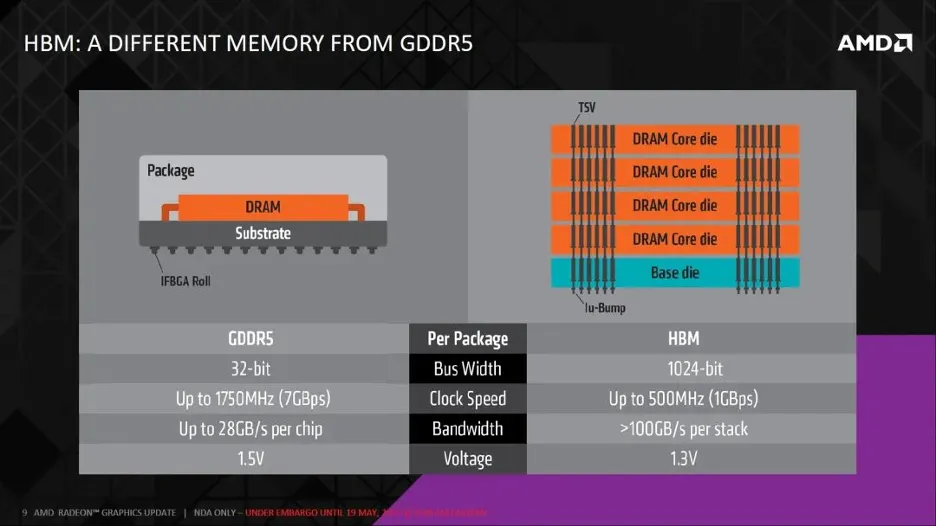
- HBM (High Bandwidth Memory) is DDR engineered for bandwidth via 3D integration, with TSV (thorugh silicon vias)
- DDR (Double Data Rate DRAM), LPDDR is low power DDR. Double means that they can transfer data in both rising and falling edge. Used in gaming GPUs.
Memory
 └── Volatile
      ├── SRAM (on-chip cache)
      └── DRAM
            ├── DDR / LPDDR
            └── HBM
| Type of DRAM | Power | Bandwidth | Capacity | Cost | Use Case |
|---|---|---|---|---|---|
| DDR | Med | Med | High | Low | PCs / Servers |
| LPDDR | Low | Med | Med | Med | Mobile / Edge |
| HBM | Med | High | Med | High | AI / GPU / HPC |
DDR vs HBM